
“Purposeful Darwinism”
A Point of View

In March 2020, US commuting to work ceased because of the pandemic. US businesses regrouped in kitchens, extra rooms in workers’ apartments. Working remotely using all the available technology became the norm. This was a far cry from the drumbeat from previous decades where managers insisted that a physical presence was required in non-farming workplace to maintain any degree of productivity. That has gone the way of the Blackberry. “US labor productivity has enjoyed a period of renewed growth over the past year, interrupting a nearly twenty-year decline: the 2.7 percent productivity growth in 2023 outpaces the 1.5 percent annual average since 2004, and it nearly matches the 2.9 percent pace seen during the country’s last productivity surge in the 1990s.”
Yesterday, one of my sons told me that his white-collar workplace will allow all employees to work remotely for the month of August. They already have a three-day work-from-home policy in place.
In the backdrop of such business practices and employer oversight, Amazon’s relentless surveillance and lack of responsiveness to worker concerns seems counterproductive. The only reason, as far as I can ascertain that the company can keep such practices in play is the seemingly large labor pool of replaceable workers. The lack of widespread unionization keeps the status quo.
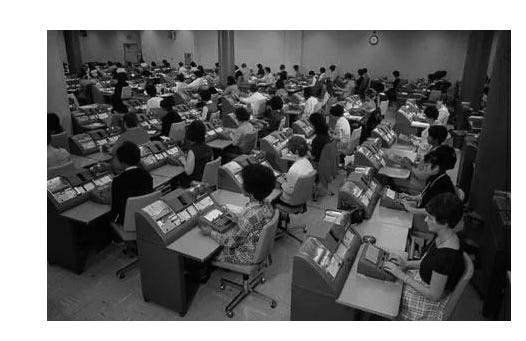
The postwar (and that’s World War II) American workplace has been in transition every decade. The go-get-them capitalism of the immediate postwar era not only put thousands to work in white-collar jobs where the glories of automation, typing pools, adding machines and telephone banks made “efficiency” and “productivity” American passwords to an enviable marketplace. A marketplace where the workers were able to share in the fruits of their labors.
(All photographs in the post are in the public domain)
That capitalist dream transformed how we viewed “progress.” Americans laughed at the English for their “loss of productivity” through labor union discussions and regular tea breaks; we laughed/sneered at the French for their month-long vacation shutdown of major commercial activity in the month of August each year. We were skeptically dismissive about the German announcements that major firms were instructing their workers away from their smartphones, checking and sending e-mails after 6 p.m.
Across the offices of the American economic engine, so to speak, whether in millennial startups or consultant offices and Fortune 500 buildings the drumbeat is of metrics and big data. The ability to gather, crunch and analyze huge amounts of information and draw conclusions about everything from what color of toothpaste we might prefer to how much gas we might be wasting when we turn on the car engine before we snap on our seatbelts and adjust our rearview mirrors before hitting the road is very much part of our lives. So when a company like Amazon makes all of these assumptions about economic productivity and individual happiness and emotional payoffs on singular efforts at the workplace the cornerstone of their business practices, I, for one, am not in the least bit surprised.
What I am surprised about is the lack of discussion about the ramifications of big-data crunching on individual privacy and more so on the individual need to earn a living so as to be able to earn the units of exchange (money) to lead physically comfortable, emotionally satisfying and economically safe lives that are separate from the organic life of the organization where we earn our units of exchange.
Amazon’s “purposeful Darwinism” is probably the only soup-to-nuts documented policy in the American workplace and so Jeff Bezos is regarded as a visionary or a demonic self-promoter, depending on where you are on the spectrum of how best to run a viable innovative and forward-thinking, customer-focused organization.
I do not for a second question the goals of a customer-centric, economically efficient, aggressively innovative company.
I do question the blanket assumption that our lives are measured and valued only by the growth at the workplace, of business productivity, of how we measure up against our peers at the workplace.
The assumption that confrontation and primal habits of survival need to be in play to bring the best out of worker productivity is destructive. What works on reality TV is not necessarily the best way to run an organization. Ask the German SS; the Fascist brownshirts; or Winston Smith in 1984.
I am not a captain of the industry and I cannot point to a large-scale counter argument (except from the moral standpoint) to Bezos’s Amazon. I can relate a data-crunching exercise that I brought to bear on worker productivity almost two decades ago.
Situation: Major company competing in high-stakes market lacks product development discipline for a large battery of products to be brought to market within a short timeframe.
Traditional incentives: Appeal to competitive natures; pizza lunches on Fridays; well-stocked kitchen for teams staying late to work.
Innovative incentive: Gather data on what the workers wanted most other than additional pay to give the company everything they had to get the products to market. Then prioritize with the teams to implement as many of these ideas as possible on a consensus basis.
Idea implemented: Dog walking — workers worried about their dogs when they worked late. Hired a few dog walkers and sectioned out the city geographically and walkers took care of dogs a few times a day.
This was the biggest need and made the teams most satisfied.
As a closing note, I quote a few lines from one of my then-reports . This is NOT possible unless managers interact with their teams, in person, as human beings. The General Patton model is unworkable.
“I just wanted to thank you for making [name of company] a better place (for me, anyway) . . . . I valued your sane perspective, your humor, and your kindness.”
________________________________________
COMING SOON
Published by Paper Lantern Books, India

(Cover photo by author. “Basilica Cistern” in Istanbul, Turkey. ALL RIGHTS RESERVED)
12 Essays
19 photographs
Three original paintings (donated by Arathi Dharani, an Indian artist working in Singapore)
WHAT PRE-PUBLICATION READERS ARE SAYING . . .
“At a time where everything is quick and easy, Revisiting the Mines is a slow and deliberate look at the world and the rich tapestry of life. The book's breadth is vast, encompassing engaging anecdotes from Shah's long career in publishing, the interplay of his family's and the country's history, as well as rich observations from his daily walks. It's a book I enjoyed dipping into at the end of each day, it infused in me a certain calmness.”
(~Veena Venugopal, author, India)
“Amit’s writing comes from a space within that has an immense capacity to capture beauty in multiples. Descriptions of trees collide with yearning for friends, lives and cities past with today, and yet each stands out with a strange evocative intensity. It’s a beautiful read, the one you’ll carry outdoors on a warm but breezy summer day.”
(~Sohini Chattopadhyay, Assistant Professor of History, Union College, NY)
Amit- Hard to believe that I’ll be reading about dog-walking and COVID and post-war all in one read, but here we are. I appreciate your overarching take and I think it is absolutely wonderful to see it through your lens. Great read. Thanks for sharing.